Is faith-based investing an all-or-nothing decision, or is there room for balance?
In this episode of Retire in Texas, Darryl Lyons, CEO and Co-Founder of PAX Financial Group, continues the two-part conversation on faith-based (biblical responsible) investing by exploring the remaining perspectives investors often hold.
Building on Part 1, Darryl focuses on investors who are fully committed to biblical responsible investing – as well as those who take a more blended approach. Through real-world examples and conversations, he unpacks how deeply held convictions, market realities, and fiduciary responsibility intersect in portfolio construction.
Episode highlights include:
-
The mindset of investors who are “all in” on biblical responsible investing, and why conviction matters.
-
Potential explanations as to why faith-based investing has underperformed the S&P 500 in recent years – and what caused the divergence.
-
How excluding the “Magnificent Seven” impacted performance across many strategies, not just faith-based portfolios.
-
The role of asset managers, shareholder advocacy, and proxy voting in responding to corporate behavior.
-
Why fiduciary duty requires flexibility – especially when certain asset classes aren’t yet available in faith-based strategies.
-
How advisors help clients balance convictions with diversification, opportunity, and long-term planning.
-
What it means to be “in the world, but not of the world” when it comes to investing.
This episode completes the four-perspective framework introduced in Part 1 and offers a practical, thoughtful approach for investors navigating faith, finances, and long-term responsibility.
To learn more or start a conversation, visit PAXFinancialGroup.com and click “Connect With Us.”
Enjoying the show? If Retire in Texas has been helpful to you, we’d appreciate it if you left a review on your favorite podcast platform. Your feedback helps more people find the show and continue the conversation.
Transcript:
Hey, this is Darryl Lyons, CEO and Co-Founder of PAX Financial Group. And thank you for tuning in today. You’re listening to Retire in Texas. This information is general in nature only. It’s not intended to provide specific investment, tax, or legal advice. Visit PAXFinancialGroup.com for more information. So, the last episode I unpacked biblical responsible investing, used synonymously with faith-based investing.
I set the stage that there’s four groups of people that I’ve met over the years and how they interact with this idea of faith-based investing. There’s group number one that I talked about in the last podcast. Those people that never heard about it before. So, I explain what it is. Then the second group that I talked about are those people who have heard about it but are deeply skeptical.
So, I unpack that in the last episode. In this episode, I want to talk about those people who are deeply convicted to invest in a biblical responsible way. And the fourth group of people that are like somewhere in between. I want some of my money in faith-based investing. Maybe not all of it. So, let’s unpack these latter two groups and just try to look through their lens and their point of view.
And again, I’m not saying this is a right or wrong thing, even, you know, really, I’m not even making a spiritual claim or just these are observations from people I’ve met over the years, having conversations about faith-based investing. So, the group that’s all in I have many friends that are just all in it.
That’s all they’ll ever do. And to be lukewarm is problematic from their lens. Why would you invest in any other way that wasn’t a biblical responsible type of investment? And I love their conviction. I actually applaud their conviction. I believe that we need people in the world that are hot for us to be lukewarm and so I loved listening to them, and I respect where they’re coming from.
In fact, many of them will trace the convictions to an antagonistic environment that existed not so much today, but not long ago, where many corporations were ostracizing Christians in the workplace. Many examples can be found on Alliance Defending Freedom’s website. But let me give you one that might help. And there’s a lot of examples out there.
And to a lot of corporations’ credit. Many of them have changed because obviously the temperature in our country has changed. The new administration. So, you can see updates. I just read an advocacy report a few minutes ago, and many of the companies are changing. Many of the CEOs were going along with whatever advocacy group was pushing an agenda or HR, and they were focused on other things.
Lots of stories behind this story. But the main thing is that were multiple episodes where Christians were being ostracized. Again, an example was Amazon Smile had excluded focus on the family because an Amazon Smile, by the way was a, it was a gifting. It was an organization where a portion of your purchases went to charitable organizations.
You just picked the charitable organization. I don’t know if you remember that. They don’t have it anymore, I don’t think, but, if you selected focus on the family as one of your charitable organizations, they would deny that charitable organization, for those that don’t know, focus on the family. This was started by Doctor James, James Dobson.
And he’s an incredible thought leader in helping moms and dads figure this whole thing out. The challenge that he faces in this environment is that people don’t like him talking about the importance of husband and wife and a mom and dad, without talking about the nontraditional types of family arrangements. And so he, by the Southern Poverty Law Center’s description, was considered a hate group.
And as a result of that, he was, and focus on the family was excluded from Amazon Smile. Those types of things and events were problematic if you were a shareholder, if you owned Amazon stock and you’re asking yourself, why would I be an owner of a company that at the same time is undermining what is most important to me is my family.
And so, people who had deeply held convictions saw these headlines and saw what was going on in the marketplace, and they refused to participate in any of it. Now, again, biblical responsible investing. Sometimes it’s black and white, sometimes it’s not. So, for example, you know, you would think, okay, alcohol is probably not going to be in a biblical responsible investing strategy, even if you do enjoy wine or whatever.
Please recognize that the majority of alcohol sales are directly to those people who are addicted, or even tobacco for that matter. Many tobacco companies will sell to 11-year-olds in India and get them addicted early on. Or, you know, DraftKings and the addictions that come with that and the misalignment of moneys. So those are the obvious ones that you could see that are, you’re going to be excluded.
It’s the more gray, the ones where there are companies that we all use their services. But all of a sudden someone in leadership or somewhere started to say, you know what? Those Christians, we have problems with them. And we’re going to start, you know, putting in policies and procedures that are going to ostracize them. And that ebbs and flows all the time.
So let me help you understand the construction of the money world. We’re a financial advisory firm. And so, what we’ll do is we will put together portfolios for clients. We might put stocks in there. We might use cash. We could use currency, Bitcoin or whatever. Oftentimes we will use funds. So, asset managers all across the country. And as an advisor, if somebody comes to me with a deeply held conviction that says I do not want anything that’s anti biblical in the portfolio, then we’ll select specific asset managers like Inspire and hear it, listen.
Inspires mission statement, inspiring transformation for God’s glory by empowering Christian investors through biblical responsible investing excellence and innovation. And so, people who have deeply held convictions, they say, I can invest with Blackrock. I could invest with Fidelity, I could invest with State Street, or I can invest with Inspire. That’s doing business for God’s glory.
I choose Inspire and there’s no copper. There’s no, there’s no cutting corners. People who have deeply held convictions are frustrated by what they’ve seen in corporate America. They want an advocate who is aligned with their values, and they don’t. They don’t care about anything else. That’s the most important thing to them. Now, Inspire is not the only one. There’s many of them.
There’s Cross Mark. There’s Timothy Plan. There’s a bunch of them out there, but they want to align their money with managers who share their values and can not only exclude companies. Here’s the deal, but also as the temperature changes in the corporate world, in the political world, they can be on top of the companies that are misbehaving.
If they’ve adopted some leadership that for some reason has problems with Christians, these managers can say, well, wait, that new CEO doesn’t like Christians, and he’s doing these things through his HR. We’re going to pull that company out of the portfolio. Or alternatively, many of these asset managers, will go in and sit in the boardroom or through their voting mechanisms, put a pebble in their shoe and try to get them to change.
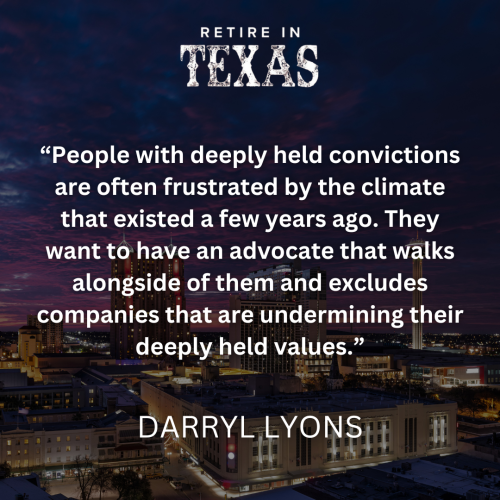
That happens a lot. So, people with deeply held convictions are often frustrated by the climate that existed a few years ago and want to have an advocate that walks alongside of them and excludes companies that are undermining their deeply held values. And I have many friends that have that passion and fire and I respect it.
So that’s the third group. The fourth group is probably the group I’m in, say probably disagree about it totally and I love these asset managers that have alignment with values. I think they’re very important. I think they’re necessary in today’s economy. We need them. We’re all just what happened is, Christians as a whole had.
And, you know, I suppose that we kind of hyper focused on our churches. Our missions are, the missionary work we do globally, our families, our soccer games. And so, we exited the advocacy and the proxy voting world and corporate America. We kind of exited and just kind of did our thing.
There is another group of people that came in and really started to push Christians around. It like I said, that’s changed. So, but for that reason, I still like, I think it’s important that we have groups, asset managers that are Christians. But here’s the challenge. And if you’ve owned faith-based investing for the last several years, hear me out.
If you look at it prior, the last 4 or 5 years, the investing, the faith-based investing world was really to me. There’s a lot of different ways you can look at that doing pretty well relative to the rest of the markets. But in the last 4 or 5 years, there’s been a divergence of performance, meaning that you, the secular world represented, generally speaking, by the S&P 500 has significantly outperformed the faith-based investing world.
Now, that’s not exactly an accurate statement, but that’s the perception. And I’ll tell you why it’s not accurate, because it’s not simply the faith-based world. The divergence of performance, meaning the S&P 500 has materially sometimes you can have outperformance. We’re all good with that. We get it. That happens. But it’s been material, meaning there’s been a significant divergence of performance between the S&P 500 and these faith-based strategies, but not just the faith-based strategies.
It’s been dividend paying strategies. It’s been something called value investing as juxtaposed to growth investing. Any investing strategy, hear me out. Any investing strategy that by their screening methodologies excluded seven companies called the Magnificent seven like the Nvidias, and the Netflix video I have to go through. I thought about that, the Magnificent Seven in a while.
Microsoft. But those specific stocks, if they were not in the portfolios, then in not in this strategy, then you didn’t get the performance of the S&P 500. It was seven stocks that really drove the entire market for the most part. Again, it kind of ebbs and flows. Last year was a little different than the year before. But it wasn’t about failure of faith-based investing.
It was about having a strategy that excluded those seven companies. And the stock market has kind of a funny way of what we call rotating, called rotation and rotating to a different sector, a different area of the markets. That’s why I don’t get too discouraged. But I do want to say there’s many, many strategies out there that didn’t own those seven.
And very smart people, very good people, very good thesis that had worked for decades before, that didn’t materialize over the last 4 or 5 years. So, if you have any frustration with faith-based investing, I don’t think it’s really faith-based investing. I think it’s just a matter of not owning the seven stocks, which you can make a case.
Well, then that’s faith-based investing. But I just want you to know that it’s not just faith based investing, dividends, value stocks, all kinds of other investing strategies that didn’t own the seven. They underperformed. I made my point. But my reason is, the reason I’m somewhere in between. All in on faith-based investing and not all in is because the faith-based universe has it mature to where I can get, all the investments I want.
So, for example, there’s not really Christian Gold Fund and you can’t get like specific sectors. So, if we want aerospace and defense, maybe for whatever’s happening in Greenland, if we want private equity, there’s not a lot of options there. So, when you build out some portfolios, it’s hard. It’s not impossible, but it’s really hard to have exposure to different investments, different asset classes or all the asset classes if you’re just using faith-based investing.
So, I consider myself a fiduciary. Fiduciary means that in fact, everyone at PAX is fiduciary, meaning that the standard has to be what’s best for our clients, not hey, we only do faith-based investing. And that’s what you got to do here. It’s like what’s best for our clients. And if that means that if your convictions are faith-based investing, then we’re going to do as much as we can, but we want to make sure we have access to other things that may not be in the faith-based world yet.
Does that make sense? Regardless of where you’re at on these, in these four areas, I’m, you know, I don’t know anything about it. I’m skeptical. I’m all in or I’m kind of somewhere in between, like I just mentioned. All good. Your journey is a journey. Like, I think the main thing is just kind of, you know, for if you’re a Christian, just read the word of God.
In fact, there’s a, in John, Jesus mentions, that He’s not of this world. And so, we often use the phrase in Christianity it’s called, I would say Christianese, to be in the world, but not of the world, kind of adopting that language of Jesus. So, we want to be in the world, but not of the world.
And that’s what I really, really, adopt in my life. So, in other words, it’s really easy for Christians to kind of, you know, get in this echo chamber and exclude ourselves from other communities. And when that happens, we wake up and our school districts don’t reflect our values. Politics don’t reflect our values. Corporate America doesn’t reflect our values because we’ve just kind of gone in this echo chamber and haven’t really participated in this whole machine.
So, I don’t have that approach. You know, I like to be involved in the city I like to be involved in and, different things going on in the world and lobby across the country in various aspects. One thing that we’re doing now that I think is worth mentioning is one of the largest asset managers in the country, Blackrock, we’ve worked with for 20 years.
So, Blackrock, one of the chief investment officers at Blackrock is named Bob Doll. He’s a Christian. And he was really spearheading portfolios for a number of years. He left. We kept Blackrock because they were working for our clients. They were helping our clients meet their goals. In the last several years, Blackrock started adopting policies that really bothered me and bothered a lot of us in America.
So what I did, is I flew up to New York and I met with some of their senior executives and met with some of their representatives and had some conversations about how there’s a group of Christians around the world that are concerned about the approach that Blackrock is taking. I don’t think that me from San Antonio, Texas, made much of a difference.
But if I at least put a pebble in the shoe of 1 or 2 people there, so that way they’ll at least consider, that they’re a group of people with deeply held convictions that actually have a lot of money, that they matter. I think that’s worth it.
So that way we can have conversations. Challenge some of the agendas that might be out there and stand firm at the same time for, you know, values that are important to Christians. So, there you have it. This is complex. I know I said a lot and certainly am proud to have been a part of this faith-based initiative that’s been going on for years now.
And there’s some amazing people that have led this way. And so I want to see how it develops. It’s going to be interesting to see how it develops. So, thank you for walking alongside of PAX. Thank you for just hanging with me on this conversation. And like I said before, and I’ve said this a thousand times, I do believe these money decisions in life, they happen to be really good when they’re done in conversation.
So, thank you for doing this podcast conversation. But if you want to meet with an advisor, a real conversation, there’s a button on our website, PAX Financial Group. Connect with us now. It’s a 15-minute consult. You just have a conversation with one of our advisors. They have hearts of a teacher. But as always, you think different when you think long term. Have a great day.
Resource: https://www.inspireetf.com/news/does-it-matter-if-i-underperform-the-s-p-500
Disclosure: This material is provided by PAX Financial Group, LLC. The opinions voiced in this material are for general information only and are not intended to provide specific advice or recommendations for any individual. The information herein has been derived from sources believed to be accurate. Please note: Biblically Responsible Investing (“BRI”) involves, among other things, screening for companies that fit within the goal of investing in companies aligned with biblical values. Such screens may serve to reduce the pool of high performing companies considered for investment. Investing involves risk. BRI investing does not guarantee a favorable investment outcome. PAX Financial Group has conducted due diligence for their Biblically Responsible Investing (BRI) process and proudly serves as each client’s advocate using fully vetted third-party specialists for the administration of BRI methodology. Past performance is no guarantee of future results. Investments will fluctuate and when redeemed may be worth more or less than when originally invested. This information should not be construed as investment, tax, or legal advice and may not be relied on for the purpose of avoiding any Federal tax penalty. This is neither a solicitation nor recommendation to purchase or sell any investment or insurance product and should not be relied upon as such.
Listen on: